


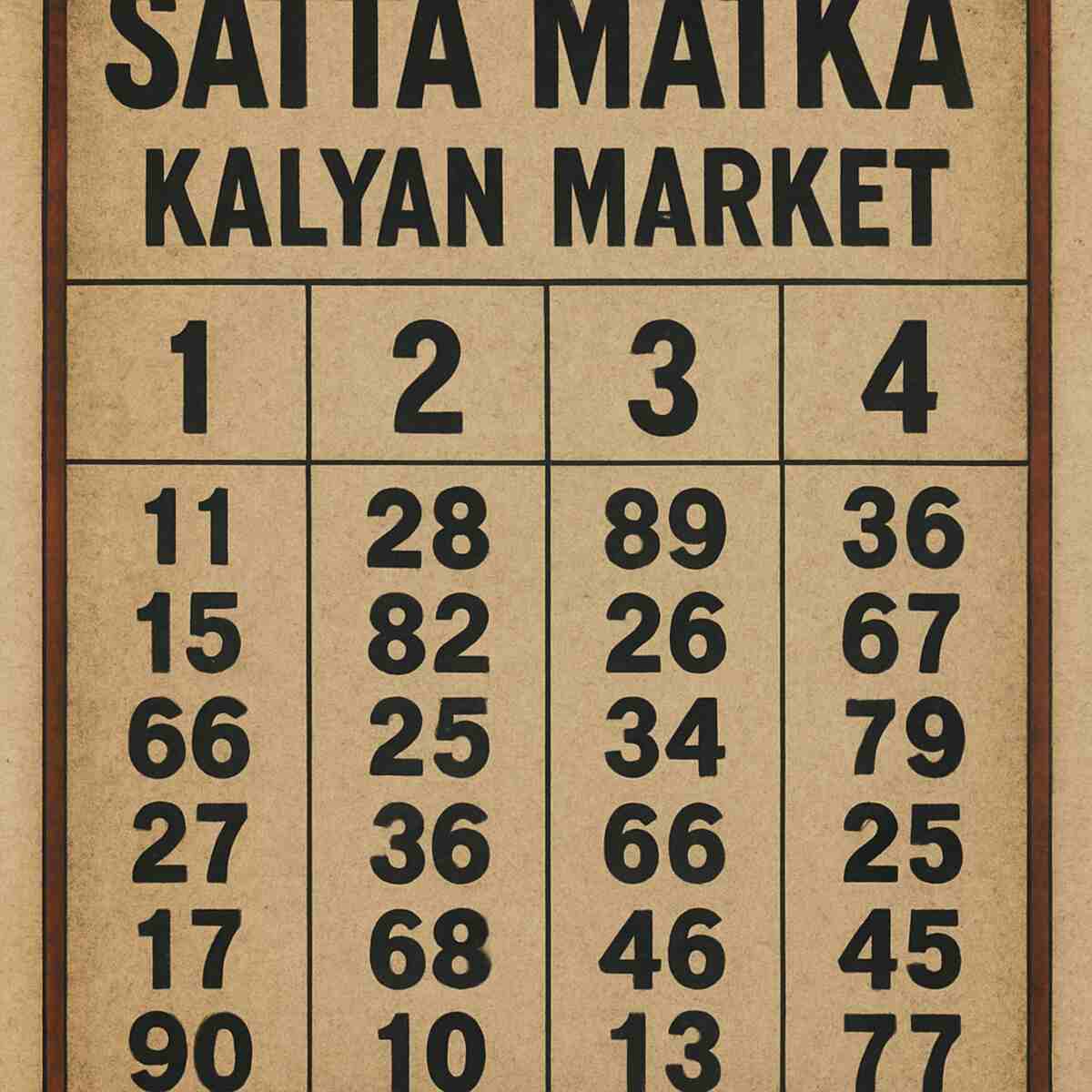

The world of speculative markets and numbers has always fascinated humanity. In India, no localized number-based system holds as much historical intrigue and cultural weight as Satta Matka, and more specifically, the Kalyan market. For decades, enthusiasts, mathematicians, and risk-takers have tried to crack the code, searching endlessly for the elusive kalyan date fix game. Check out the Best info about jago89 login.
This comprehensive guide dives deep into the origins, evolution, and mechanics of the Kalyan market. We will explore the mathematical realities behind the draws, the industry’s historical context, and the risks associated with modern digital betting. Whether you are a historical enthusiast, a student of probability, or someone trying to understand the cultural phenomenon behind these numbers, this exploration will provide an objective, educational, and detailed perspective.
You might also like


The Origins of Satta Matka and the Kalyan Market
To understand the concept of a date fix game kalyan, one must first look at how this vast network of numbers began. The roots of Satta Matka trace back to the bustling streets of pre-independence Mumbai (then Bombay). In the 1950s, the practice originated as “Ankada Jugar” (number gambling), which involved betting on the opening and closing rates of cotton transmitted to the Bombay Cotton Exchange from the New York Cotton Exchange via teleprinters.
When the New York Cotton Exchange stopped this practice in 1961, punters were left looking for alternative ways to keep the localized betting economy alive. Enter Kalyanji Bhagat, a visionary in this underground world. In 1962, he introduced a new system that replaced cotton rates with playing cards and, eventually, slips of paper drawn from a large earthen pot known as a “Matka.”
This gave rise to the legendary Kalyan Matka market. Unlike other markets that operated only on weekdays, the Kalyan market introduced a system that ran seven days a week, making it incredibly popular among textile mill workers and local merchants.
Tracking the history of Kalyan market results shows a fascinating evolution. In the 1970s and 1980s, the market reached its peak. The results were awaited with bated breath, often distributed through local newspaper networks and word of mouth. It was during this golden era that the mythos of the “fix” number began to take shape.
What Exactly is the Kalyan Date Fix Game?
The term “date fix” in the Matka ecosystem refers to a highly sought-after, supposedly guaranteed result predetermined for a specific date. A Kalyan date-fix game is considered the Holy Grail among players. The premise is that insiders, bookies, or highly skilled mathematicians possess a number—whether an open, close, or a full Jodi—that is 100% guaranteed to be drawn on a particular day.
Every day, thousands of enthusiasts search the internet for a date fix game kalyan today, hoping to find a shortcut to financial gain. The psychology behind this is simple: the human mind craves certainty in an uncertain environment. By labeling a game as “date fix,” local bookmakers and modern online tipsters create a sense of artificial security.
However, it is vital to understand that the true nature of Satta Matka is based on randomized draws (or pseudo-randomized in modern digital formats). The historical concept of a true date fix game kalyan was often nothing more than a marketing gimmick used by early bookies to drum up massive volume on specific festival days or weekends.
Decoding the Terminology: Pannas, Jodis, and Opens
Before diving into the complex mathematics and strategies, one must understand the unique lexicon of the Kalyan market.
- Open and Close: The draws happen twice a day. The first draw is the “Open” and the second is the “Close.”
- Jodi: A pair of numbers formed by combining the final digits of the Open and Close draws. For example, if the Open is 4 and the Close is 5, the Jodi is 45.
- Panna (or Panel): A three-digit result drawn from a deck of cards or digital RNG.
A common question among beginners is: What is a single panna in Matka? A single panna is a three-digit combination in which all three digits are unique (e.g., 147). To find the primary number (the Open or Close digit), add the three digits of the panna. For 147, the sum is 1 + 4 + 7 = 12. The last digit of the sum is 2. Therefore, 2 is the primary drawn number.
There are also Double Pannas (where two digits repeat, such as 114) and Triple Pannas (where all three digits repeat, such as 111). The payout structures for these vary widely due to differences in their underlying probabilities.
The Evolution of Satta Matka Guessing Techniques
Over the last sixty years, players have developed incredibly intricate Satta Matka guessing techniques. What started as pure intuition evolved into complex pseudo-mathematical systems. In the 1980s and 90s, the streets of Mumbai were filled with small, pocket-sized booklets known as Matka trick books.
How to Use Matka Trick Books
Learning how to use Matka trick books was considered a rite of passage for serious players. These books contained pages of astrological charts, numerical grids, and historical data. They taught players how to look for “cut numbers” (the opposite of a number on a 0-9 scale, where 1 is the cut of 6, 2 is the cut of 7, etc.) and “family numbers.”
Modern players still utilize these foundational principles, digitizing them into apps and forums. Some of the most closely guarded secrets are the Kalyan Matka lifetime tricks. These are foundational rules that players believe remain constant across eras. Examples include:
- The Difference Trick: Subtract the Open digit from the previous day’s Close to estimate the upcoming Open.
- The Weekly Sum: Tracking the total number of Jodis in a specific week to predict the weekend “fix” game.
- Family Pairing: Believing that if a 2 is drawn, a 7 is highly likely to follow in the subsequent cycle.
Analyzing the Charts: The Backbone of the Game
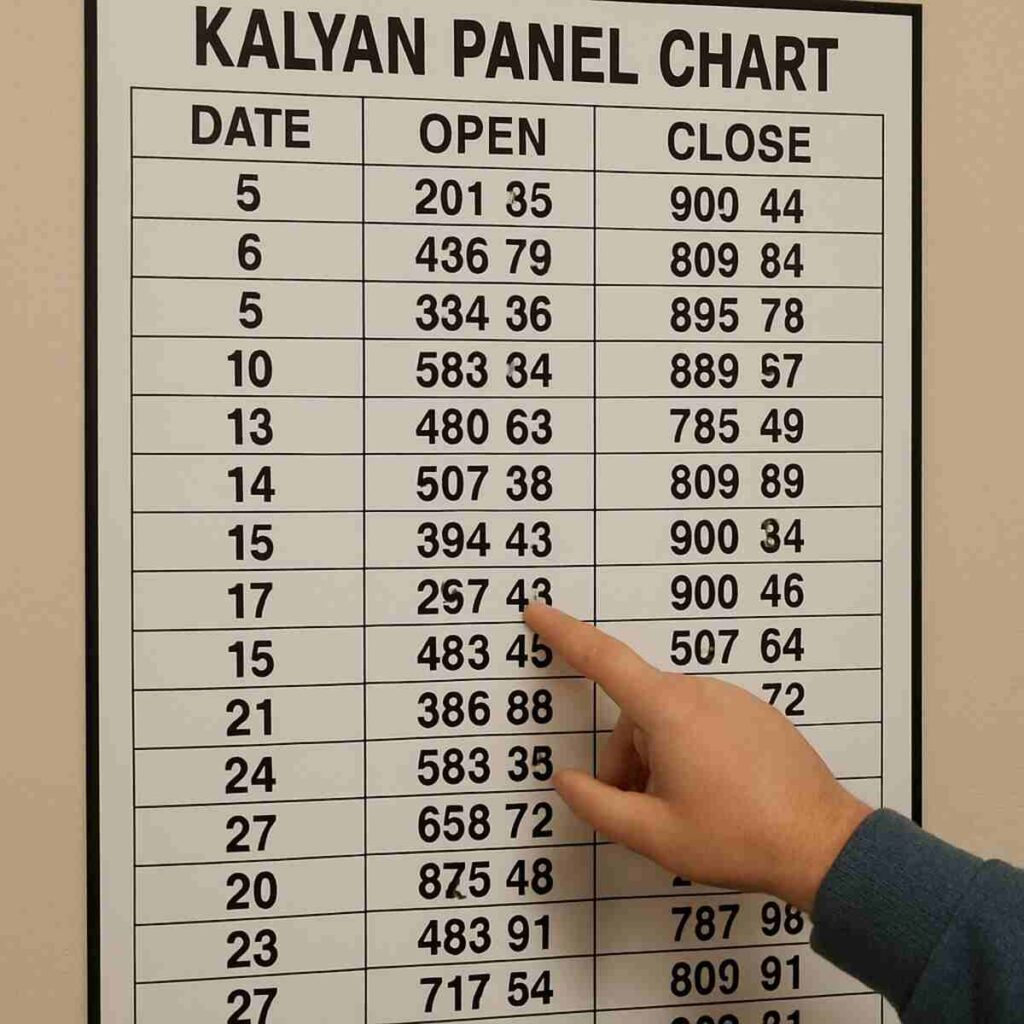
To execute any guessing technique, players rely heavily on historical data. This brings us to the critical skill of reading Kalyan panel charts.
A panel chart is a massive, multi-year grid that logs every single Panna and Jodi drawn in the Kalyan market. Reading these charts is akin to technical analysis in stock trading. Players do not just look at the numbers; they look at the geometry of the grid.
Daily Kalyan Jodi Record Analysis
Effective daily Kalyan Jodi record analysis involves looking for patterns both vertically and horizontally.
- Vertical Analysis: Players look at the Jodi drawn on a specific day (e.g., Monday) and compare it to the Jodis drawn on the previous four Mondays. They search for sequential jumps, repeating digits, or sum totals that align.
- Horizontal Analysis: This involves looking at the progression of numbers from Monday through Saturday. If the week starts with low-sum Jodis (like 12, 03, 14), a player might predict a high-sum Jodi (like 89 or 77) by the weekend to “balance” the chart.
- Diagonal Matching: A highly advanced technique where players trace diagonal lines across the grid, believing that the algorithm or the person pulling the numbers unconsciously follows geometric patterns.
The Mathematics Behind Matka: Is it Just Luck?
At its core, Satta Matka is a game of probability. While players spend hours on Kalyan open-to-close prediction methods, the underlying math is immutable. Understanding Satta probability math is crucial for anyone analyzing this market objectively.
Let’s break down the mathematical formulas for Matka numbers.
- The Single Digit (Open or Close): There are 10 possible digits (0 through 9). The probability of guessing a single digit correctly is exactly 1 in 10, or 10%.
- The Jodi: Because a Jodi consists of an Open digit (10 possibilities) and a Close digit (10 possibilities), there are 100 possible Jodis (00 to 99). The probability of accurately guessing a Jodi is 1 in 100, or 1%.
- The Panna: Calculating its probability is more complex. Because the digits are sorted in ascending order (e.g., 123, never 321), and there are Single, Double, and Triple Pannas, the total number of valid Pannas is 220. Thus, correctly guessing a Panna has roughly a 1-in-220 chance (0.45%).
Despite these harsh mathematical realities, players use summation formulas and moving averages to try and narrow down the 100 Jodi possibilities to a smaller “playing set” of 4 to 8 numbers, hoping to increase their odds. However, statistically, each draw is an independent event. The pot (or the computer) does not remember what number it drew yesterday.
The Dark Side: Scams, Frauds, and Fake Providers
Where there is money and risk, there are inevitably bad actors. The transition of the Kalyan market from physical bookies to the internet has led to an explosion of scams. The myth of the kalyan date fix game is the primary bait used by online fraudsters.
Identifying Fake Matka Number Providers
Today, thousands of YouTube channels, Telegram groups, and websites claim to have inside information. Identifying fake Matka number providers is paramount for anyone navigating this space. Here are the red flags:
- Demanding Advance Payment: The most common scam. The provider will ask for an “advance fee” in exchange for a “100% sure date fix game.” Once the money is sent via UPI or crypto, the user is blocked.
- Photoshop and Edited Charts: Scammers frequently post screenshots of WhatsApp chats showing incredible wins. These are easily fabricated.
- “Company Leaks”: Providers often claim they have a hacker inside the “Matka Head Office.” Satta Matka is decentralized; there is no centralized corporate office that can be “hacked” in this manner.
Verifying Leaked Matka Numbers
Is it possible to verify these claims? The short answer is no. Verifying leaked Matka numbers is impossible because genuine leaks do not exist in the modern, decentralized digital era. The numbers are either drawn via a localized randomizer or managed by highly guarded algorithms. Anyone claiming to offer a verified leak is attempting to capitalize on player desperation.
Common Satta Matka Fraud Alerts
To protect oneself from the predatory side of the internet, it is vital to be aware of common Satta Matka fraud alerts.
- The “After Pass” Scam: A fraudster gives out different numbers to 100 different people for free, telling them to pay after they win. Since there are only 100 Jodis, one person is guaranteed to win. The scammer then pressures that single winner for a massive payout, pretending they knew the result all along.
- Fake Application Phishing: Downloading unverified Matka applications can install malware that steals banking credentials and personal data.
- VIP Memberships: Charging exorbitant monthly subscription fees for access to “exclusive” prediction rooms that offer nothing more than random guesses.
Risk Management in Satta
For those who view Satta Matka as an extreme form of speculative entertainment, treating it without caution is a recipe for financial ruin. Objective analysts apply strict risk assessments to Satta betting, similar to those for high-risk day trading in the financial markets.
A proper risk assessment framework includes:
- Bankroll Management: Never risking more than 1% to 2% of total disposable capital on a single draw.
- Avoiding the “Chase”: The most devastating mistake players make is doubling down after a loss to win back their money—a phenomenon known as the Martingale fallacy.
- Emotional Detachment: Treating a loss as the mathematical norm rather than a personal failure or a sign of bad luck.
- Setting Strict Time Limits: Satta Matka’s twice-daily draws can easily lead to compulsive behavior. Setting limits on how much time is spent analyzing charts is crucial for mental health.
Ultimately, understanding the house edge—the mathematical advantage the bookmaker has over the player—is the best form of risk management. Because the payouts are always slightly less than the true odds of the draw, the house always wins in the long run.
The Legal Landscape: Gambling Laws in India
No comprehensive guide to the Kalyan market is complete without addressing the elephant in the room: legality. Satta Matka operates in a highly complex and largely prohibited legal gray area in India.
The legal consequences of Indian gambling laws are rooted in the Public Gambling Act of 1867. This colonial-era law prohibits running a public gaming house and outlaws most forms of gambling that rely on chance rather than skill. Because the Supreme Court of India has historically classified betting on random numbers as a game of chance, Satta Matka is illegal in most of the country.
However, gambling is a state subject in India. This means individual states have the right to formulate their own laws regarding betting and wagering.
- States like Goa, Sikkim, and Meghalaya have legalized certain forms of casino gambling and lotteries.
- States like Maharashtra (the historical birthplace of Kalyan Matka) maintain strict bans on Satta operations, leading to frequent crackdowns by local law enforcement.
Engaging in underground or unregulated online Satta Matka can lead to severe legal repercussions, including heavy fines and potential imprisonment. Furthermore, because the industry operates outside the law, players have no legal recourse or consumer protection if they are scammed or a bookmaker refuses to pay out a massive win.
The Modern Digital Era of Kalyan Matka
As we look at the industry today, the traditional earthen pot has largely been replaced by servers and smartphone applications. The essence of the game remains the same, but the delivery mechanism has shifted entirely.
The digitalization of the market has made it more accessible but also more volatile. Today, a player sitting in a tier-3 city can instantly view the history of Kalyan market results on their phone, run their algorithms, and place bets through digital intermediaries.
This technological shift has also given rise to sophisticated software designed to aid players. From automated calculators that compute mathematical formulas for Matka numbers to AI-driven bots that analyse daily Kalyan Jodi records, technology is attempting to bridge the gap between pure luck and calculated prediction.
Yet, despite all the processing power and digital tools, the foundational truth remains unchanged: the draw is random. The kalyan date fix game remains a modern myth—a digital ghost chased by those hoping to beat an unbeatable mathematical system.
Conclusion
The Kalyan market is a fascinating case study in human psychology, mathematics, and localized economics. From its humble beginnings in the cotton exchanges of Bombay under Kalyanji Bhagat to the sprawling digital networks of today, it remains deeply embedded in certain subcultures.
While Satta Matka guessing techniques, panel chart analysis, and intricate mathematical formulas offer an engaging intellectual puzzle, they cannot alter the fundamental laws of probability. The allure of a guaranteed date fix game kalyan today is a powerful marketing tool used by scammers, and understanding this is vital for anyone researching the market.
By learning how to read Kalyan panel charts, understanding what a single panna in Matka is, and recognizing the common Satta Matka fraud alerts, one can demystify the game. However, one must always balance this knowledge with a clear understanding of the severe legal consequences of Indian gambling laws and the critical importance of risk assessment for Satta betting.
Ultimately, Satta Matka is a game of chance heavily weighted against the player. Recognizing the history, the math, and the risks provides a holistic, clear-eyed view of one of India’s oldest and most notorious speculative markets.